Martina Wilsch presented at the international IMISCOE conference in Girona
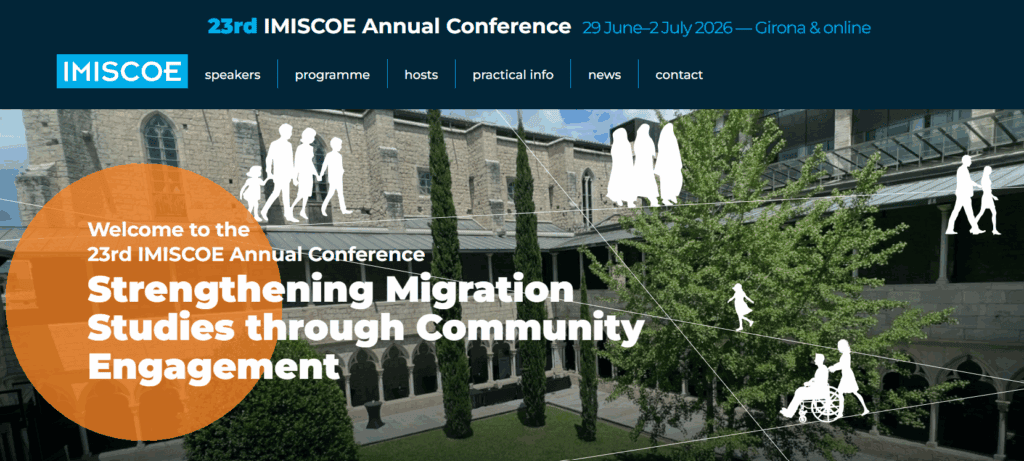
Our colleague Martina Wilsch participated in the 23rd IMISCOE Annual Conference, held from 29 June to 2 July 2026 in Girona, Spain. IMISCOE is among the most important international scholarly forums in the field of migration studies and is the largest European network bringing together researchers working on migration, integration, and diversity. This year’s conference, held in Girona and online, welcomed approximately 1,400 participants, with a programme comprising nearly 300 panels and workshops.
Martina Wilsch presented in the panel (Con)figurational Approaches to Transnational Families in Forced Migration Contexts, together with Prof. Ute Karl from the Protestant University of Applied Sciences in Ludwigsburg. Their paper was entitled Care and Social Support in Dynamic Figurations of Displaced Ukrainian Families: Reflections from Germany and Slovakia.
The panel contributed to current debates on transnational families in the context of forced migration. The individual papers drew on a relational, or (con)figurational, approach, which makes it possible to examine family life not as an isolated set of relationships, but as a process co-constructed within broader networks of personal, community, institutional, and transnational ties. The panel focused in particular on how forced displacement, the separation of family members, the loss of established forms of solidarity, new informal ties, and different socio-political contexts shape care, support, and the everyday functioning of families. All papers in the panel addressed Ukrainian forced migration and were based on empirical research conducted in Germany, Switzerland, Slovakia, and Romania. Together, they showed how family and support networks are transformed across geographical borders and beyond kinship relations.
The paper by Martina Wilsch and Ute Karl focused on the dynamics of care and social support among displaced Ukrainian families in Germany and Slovakia. The authors examined how practices of care and support are shaped by relationships with institutions, family, communities, and other social ties, conceptualising them, from a figurational perspective, as constellations of care and social support. Drawing on a comparative approach to qualitative longitudinal research in Germany and longitudinal ethnographic research in Slovakia, they highlighted the importance of welfare regimes, access to the labour market, housing, community support, geographical proximity to Ukraine, and the transnational dispersion of family members’ and friends’ support networks. The paper also emphasised the added value of a longitudinal and figurational approach for better understanding the changing needs of Ukrainian refugees.
The paper was prepared as part of the APVV project VV-MVP-24-0203 Family on the Edge: Current Contexts of Vulnerability and Transnational Family Transformations (RONARO).