Photographic Meadow: Visual Archives in the Making of Ecological Memory and Land-Care Knowledge
Grant Scheme: APVV
Project ID: APVV–25–0629
Title of Project: Photographic Meadow: Visual Archives in the Making of Ecological Memory and Land-Care Knowledge
Acronym: PHOMEA
Project Duration: 1. 9. 2026 – 31.8.2030
Principal Investigator: Institute of Ethnology and Social Anthropology SAS
Project Partners: Institute of Geography SAS, Plant Science and Biodiversity Centre SAS
Project Leader: Mgr. MgA. Jaroslava Panáková, PhD.
Project description:
Photographic Meadow is an interdisciplinary research project centred on the anthropological analysis of Carpathian meadows as historically, ecologically, and culturally layered landscapes, examined through systematic work with visual data. Grounded in environmental and visual anthropology and developed in dialogue with botany and geography, the project investigates what kinds of knowledge about biodiversity, land care, and long-term landscape change can be reconstructed and elicited from archival and contemporary visual sources.
The core of the project consists of a systematic analysis of ethnographic photographic archives (primarily the collections of the Institute of Ethnology and Social Anthropology of the Slovak Academy of Sciences, including documentation linked to the research of Ján Podolák and subsequent generations of scholars), combined with historical and contemporary aerial and satellite imagery. These visual materials are approached not as illustrative supplements but as full-fledged epistemic media that convey ecological memory and make visible long-term transformations of human–more-than-human relations in meadow landscapes.
Anthropological analysis focuses on visually legible traces of past and present land-use practices (mowing, grazing, succession), spatial patterns of care, maintenance, and neglect, and the ways in which meadow biodiversity becomes culturally perceived, interpreted, and valued. Methodologically, the project combines visual and archival analysis, sensoryanthropological approaches to visual elicitation, botanical interpretation of vegetation indicators, and geographical analyses of landscape change.
The project will result in an anthropologically grounded analytical framework for working with visual archives in environmental research, enabling the integration of historical ethnographic documentation with contemporary debates on biodiversity, land care, and the regeneration of cultural landscapes in the Carpathian region.
Project aims:
The main objective of the project Phomea: The Photographic Meadow is to analyse Carpathian grasslands as historically, ecologically, and culturally layered landscapes through visual data, and to examine how archival and contemporary visuality mediates ecological memory, landscape care, and long-term transformations of landscape regimes.
- To examine the epistemic potential of visual data—ethnographic photography, archival aerial imagery, and contemporary satellite data—for identifying long-term changes in biodiversity, land-use practices, and landscape structures of Carpathian grasslands.
- To analyse archival photographic collections within the frameworks of environmental anthropology and historical ethnography in order to reconstruct visual traces of meadow management and to identify continuities and discontinuities in landscape use over time.
- To integrate anthropological interpretations of visual materials with botanical and geographical knowledge of grassland ecosystems and to develop an interdisciplinary analytical framework for the study of semi-natural cultural landscapes.
- To develop the concept of meadow ecological memory as an analytical tool for examining relationships between humans, landscape, and biodiversity in the context of long-term ecological change.
- To contribute to methodological innovation in environmental and visual anthropology through systematic engagement with visual archives, aerial photography, and satellite-based Earth observation data.
- To design and implement a multimodal anthropological dissemination strategy combining: (1) a curated exhibition, (2) public workshops and discussions, and (3) an online photographic database (Phomea – The Photo-Ecological Memory of Meadows).
- To communicate meadow ecological memory, biodiversity, and forms of landscape care through visually grounded, interdisciplinary interpretation, with the aim of strengthening ecological literacy and fostering dialogue between researchers, conservation practitioners, farmers, educators, and the wider public.
- To establish an open, sustainable online photographic database as a long-term visual research infrastructure enabling analytical, educational, and comparative work with photographs in temporal and thematic perspectives, and linking local meadow knowledge to broader transdisciplinary frameworks, particularly in the areas of One Health, environmental risk, and human–animal–landscape relations.
Details about the Project Implementation
Project Management and Coordination
The APVV-25-0629 project Photographic Meadow: Visual Archives in the Making of Ecological Memory and Land-Care Knowledge (PHOMEA) officially commenced on 1 September 2026. The project will run until 31 August 2030.
Ongoing Outputs and Results of the Project
2026
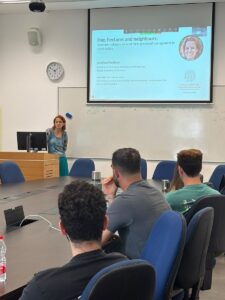
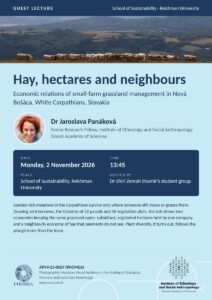
On 2 November 2026, Jaroslava Panáková (Institute of Ethnology and Social Anthropology, Slovak Academy of Sciences) delivered an invited lecture entitled Hay, hectares and neighbours: Economic relations of small-farm grassland management in Nová Bošáca, White Carpathians, Slovakia at the School of Sustainability, Reichman University, Herzliya, Israel. The lecture was held at the invitation of Professor Shiri Zemah Shamir, with whom Jaroslava Panáková submitted a joint research proposal in September 2026 under the APVV Slovakia–Israel (SK–IL) bilateral cooperation scheme.
The lecture explored the economic relationships underpinning small-scale grassland management in Nová Bošáca, in the White Carpathians. Species-rich Carpathian meadows persist only where mowing or grazing practices are actively maintained. Drawing on interviews, the land-use histories of 52 parcels, and data from 46 vegetation plots, Jaroslava Panáková demonstrated that two distinct economies sustain the same open meadow landscapes: a system of subsidised, registered hectares concentrated under the management of a single company, and a neighbour-based hay economy that remains invisible to the agricultural payment system. The findings further suggested that plant species diversity is more closely associated with historical land-use practices, particularly ploughing, than with the form of land tenure.
The lecture drew on research conducted within the project PHOMEA – Photographic Meadow: Visual Archives in the Making of Ecological Memory and Land-Care Knowledge (APVV-25-0629), which integrates ethnographic and ecological approaches to the study of Carpathian meadows.
Picture 1

Picture 2:
Picture 3: Poster
From 28 October to 7 November 2026, Jaroslava Panáková undertook a research visit to Israel as part of the project PHOMEA – Photographic Meadow (APVV-25-0629). The visit included fieldwork, archival research, and expert consultations.
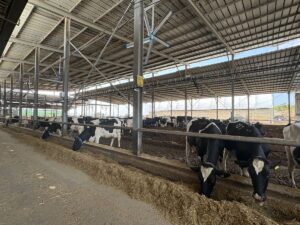
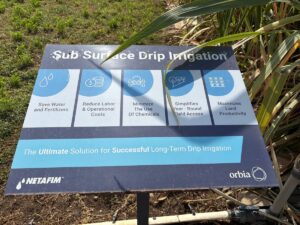
The programme included a visit to Netafim’s educational centre dedicated to drip irrigation technologies and a consultation with Itamar Nadav, Head of Research and Innovation at Netafim Agronomy. Jaroslava Panáková also visited a family-run dairy farm, where she had the opportunity to learn about agricultural practices in Israel.
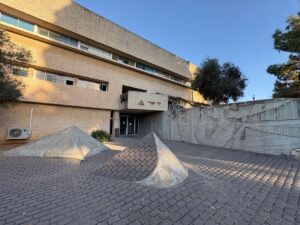
At the Yad Yaari and Yad Tabenkin archives, she collected photographic and other visual data.
She also visited several exhibitions of contemporary Israeli photojournalism and Bar-Ilan University, where she has maintained a long-standing research collaboration with Professor B. Kotlerman in the field of local oral history.
Pictures (J. Panáková)
Picture 1:
Picture 2:
Picture 3:

Picture 4:
Picture 5:

Two events featuring Professor Hiroki Takakura of Tohoku University will take place in Bratislava on 5 and 6 October 2026. On 5 October, he will give a public lecture on human–animal relations in Siberian anthropology, followed on 6 October by a seminar on culture and post-disaster recovery after the 2011 earthquake and tsunami in Japan.
More information is available HERE.
On 12 October 2026, Jaroslava Panáková (Institute of Ethnology and Social Anthropology, Slovak Academy of Sciences) delivered an invited lecture titled Affective Images, Ecological Memories: Photography between the Arctic Tundra and the Carpathian Meadow at the Institute of Ethnology and Cultural Anthropology, Jagiellonian University in Kraków.
The lecture explored the concept of affective knowledge and its relationship to memory, particularly ecological memory. Jaroslava Panáková discussed how she initially developed this concept through research on the family photographic archives of Indigenous inhabitants of Chukotka and subsequently applied it to the study of Carpathian meadows. She demonstrated how photographs not only preserve memories but also mediate knowledge of changing environments through affective and sensory experiences.
This approach underpins the PHOMEA – Photographic Meadow (APVV-25-0629) project, which she introduced in the second part of the lecture. The project investigates how archival ethnographic photographs, historical aerial imagery, and repeat photography can be used to explore the ecological memory of meadows. Mowing, grazing, drainage, and land abandonment leave traces in the landscape that can be identified and interpreted through photographs and brought into dialogue with the contemporary experiences of local inhabitants.
The lecture thus connected visual anthropology with ecological research, raising questions about photography as a means of understanding relationships between people, landscapes, and their transformations.