Slovenský národopis
Vydavateľ: Ústav etnológie a sociálnej antropológie SAV, v. v. i.
ISSN 1335-1303 (tlač)
ISSN 1339-9357 (online)
Kontakt
Redakcia Slovenského národopisu
ÚESA SAV, v. v. i.
Klemensova 19
813 64 Bratislava
Tel.: 02 – 52964707, ext. 107
e-mail: slovensky.narodopis@savba.sk
Najnovšie čísla
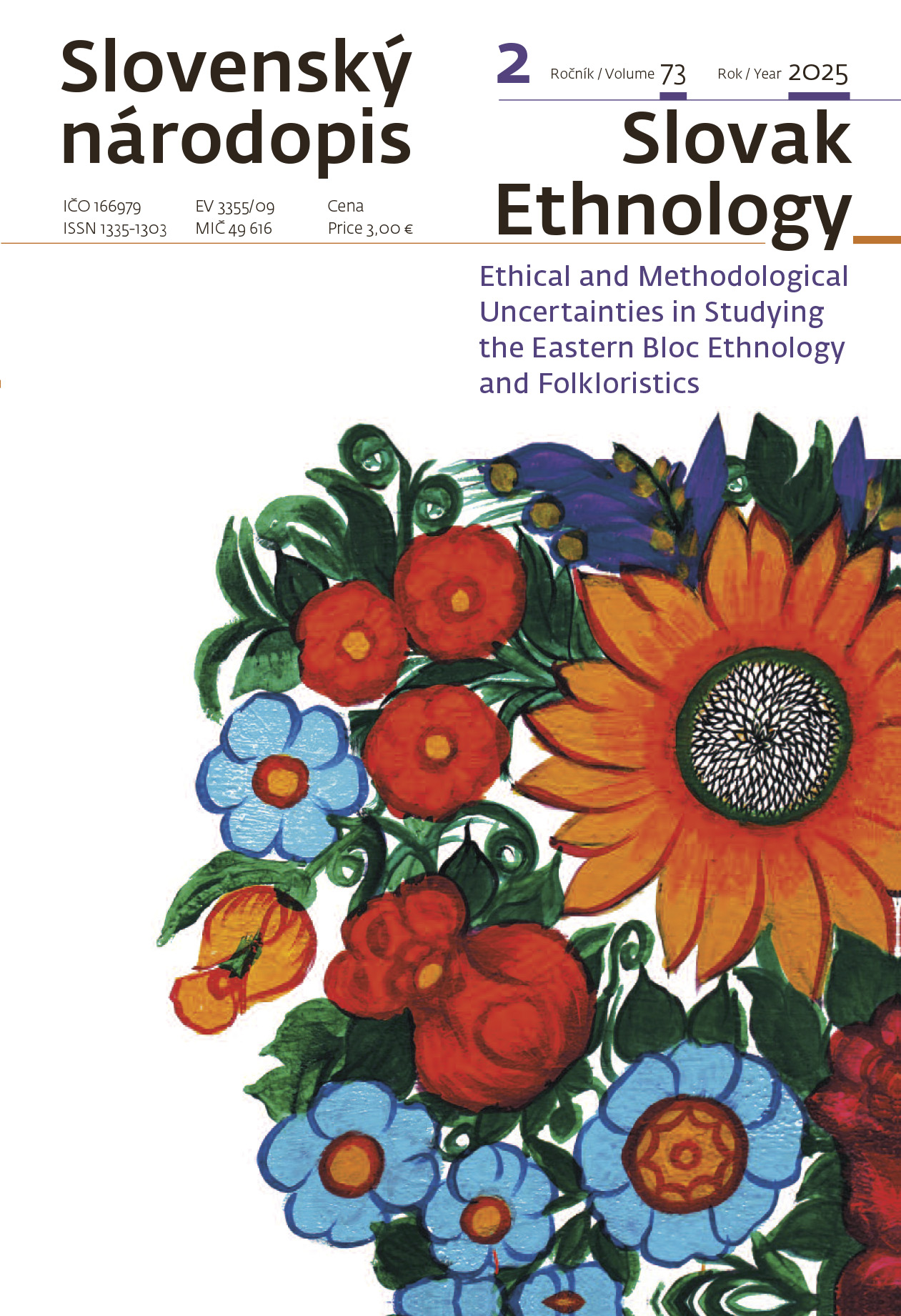
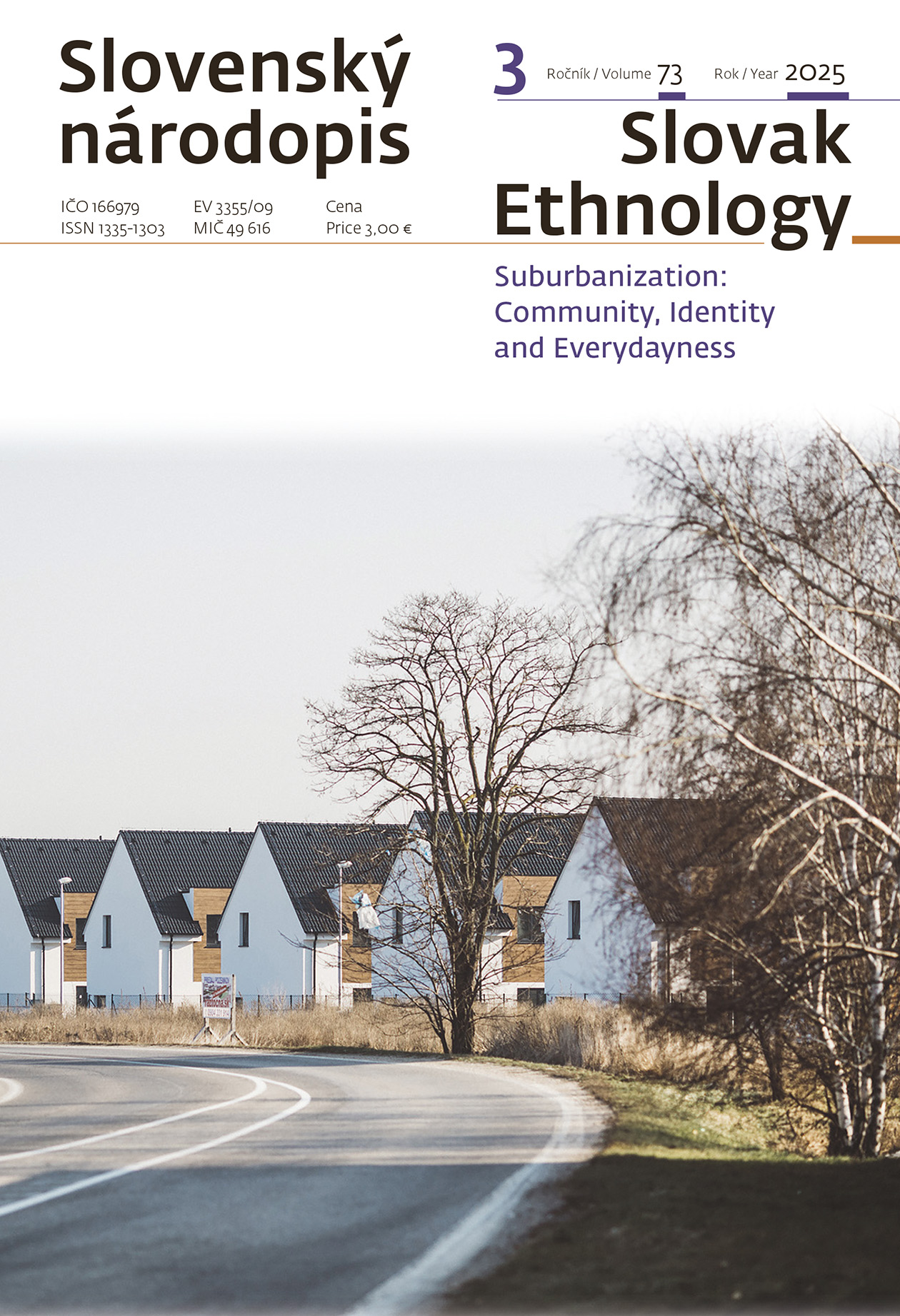
Slovenský Národopis je evidovaný v nasledujúcich databázach:
Emerging Sources Citation Index of Web of Science (ESCI, WoS), SCOPUS, DOAJ, EBSCO, ProQuest, CEEOL, The Central European Journal of Social Sciences and humanities (CEJSH), Modern Language Association (MLA), Ulrichsweb, Willingspress, Norwegian Centre for Research Data (NSD), European Science Foundation (ESF), European Reference Index for the Humanities and the Social Sciences (ERIH PLUS)
Príspevky uverejnené v časopise sú teritoriálne orientované prevažne na región Strednej Európy. Zameriavajú sa na analýzu sociálnych javov založenú na dátach získaných predovšetkým prostredníctvom metód etnografického terénneho výskum. Redakcia časopisu preferuje príspevky analytického, teoretického alebo syntetizujúceho charakteru, ktoré prispievajú k aktuálnym diskusiám v sociálnych vedách. Tematicky je časopis sústredený najmä (nie však výhradne) na etnický, kultúrny a historický vývin v Strednej Európe, na sociálne a kultúrne aspekty ekonomickej a politickej transformácie, na modernizačné procesy v urbánnom i rurálnom prostredí, na etnickú a menšinovú problematiku, na problémy kultúrneho dedičstva v európskom kontexte, ako aj na dejiny spoločenskovedných disciplín. Okrem problémovo orientovaných vedeckých štúdií časopis uverejňuje tiež eseje, diskusie a recenzie kníh. Časopis poskytuje priestor na diskusie o kľúčových problémoch v sociálnych vedách, ako aj na kritické komentáre k publikovaným príspevkom. Uverejnené štúdie a eseje prešli obojstranne anonymným oponentským konaním, oponenti sa vyberajú z medzinárodného okruhu odborníkov.
Výzvy
The issue of Slovenský národopis/Slovak ethnology seeks contributions dealing with innovative participatory methods that engage older adults as equal collaborators in research, policy, and practice designs. We welcome case studies, methodological insights, and theoretical reflections showing how participatory practices can rewrite conventional power dynamics.
Guest editors
Heidi Kaspar, Bern University of Applied Sciences, Institute for Collaborative Practice and Leadership in Healthcare, Bern, Switzerland (https://orcid.org/0000-0002-1668-5855)
Sandra Staudacher, FHNW University of Applied Sciences and Arts Northwestern Switzerland, Switzerland (https://orcid.org/0000-0002-3762-2407)
Ľubica Voľanská, Institute of Ethnology and Social Anthropology, Slovak Academy of Sciences, Bratislava, Slovakia (https://orcid.org/0000-0003-3267-5240)
Call for Papers
Slovenský národopis / Slovak Ethnology, 2/2027
Participatory Approaches in Ethnology, Anthropology: Methods, Ethics and Power Relations
Slovenský národopis / Slovak Ethnology invites contributions for a special issue dedicated to participatory approaches with older adults in ethnology, social and cultural anthropology, medical anthropology, social, cultural, economic and political geography, sociology, heritage studies, museum studies and related fields.
Participatory research has become an increasingly important way of producing knowledge with, rather than merely about, communities, groups and individuals. Such approaches are closely connected to questions of collaboration, shared ownership, co-creation, public engagement, community expertise, epistemic agency and the politics of representation. They raise complex methodological and ethical issues: Who defines the research questions? How are roles, expectations and responsibilities negotiated? What forms of knowledge are recognised as legitimate? How can researchers work with asymmetries of power, institutional hierarchies and unequal access to resources? And how can participatory processes be evaluated beyond simple claims of inclusion?
This issue seeks to explore participatory approaches as situated, negotiated and often ambivalent research practices (Urbaniak, Wanka 2024). We welcome empirically grounded, theoretically informed and reflexive contributions that examine both the possibilities and the limits of participatory practices and research with older adults. Contributions may address successful examples of collaboration, but also tensions, failures, misunderstandings, ethical dilemmas and practical constraints that shape participatory work in knowledge production.
We are particularly interested in contributions dealing with one or more of the following themes:
- participatory, collaborative, community-based and action-oriented research in ethnology and anthropology and related fields;
- co-creation of knowledge in heritage, museum and memory work;
- participation of older adults or intergenerational groups in research and cultural projects;
- power relations between researchers, institutions, professionals and participants;
- shared authority, authorship, ownership and representation;
- ethical challenges in participatory research, including consent, expectations, care, reciprocity and long-term responsibility;
- methodological reflections on time, trust, conflict, failure and sustainability in participatory processes;
- critical perspectives on tokenism, consultation fatigue and institutional instrumentalisations of participation.
The special issue aims to bring together contributions that reflect on participatory approaches across different empirical settings, including local communities, cultural institutions, activist contexts, health and care settings, educational environments, intergenerational projects, co-creation of knowledge with older adults and/or on ageing and/or on inter-generational relations, heritage initiatives and applied research. Comparative, historical, and theoretical contributions are also welcome, provided they clearly engage with the methodological, epistemological, or ethical dimensions of participation.
We invite the following types of contributions:
- original research articles;
- theoretical or methodological essays;
- reflexive case studies;
- discussion papers;
- book essays or review essays connected to the theme of the issue.
Manuscripts should be submitted in English. All submitted research articles will undergo the journal’s standard double-blinded peer-review process.
Indicative timeline
- Submission of abstracts: 15. September 2026
- Notification of acceptance of abstracts: 1. October 2026
- Submission of full manuscripts: 31. January 2027
- Peer review and revisions: February–April 2027
- Final revised manuscripts: 15 May 2027
- Publication of the issue: June/July 2027
Abstract submission
Contributors are kindly requested to submit their abstracts of up to 300 words and keywords directly through the editorial system of Slovak Ethnology (https://journals.savba.sk/index.php/slovenskynarodopis/about/submission) no later than 15 September 2026.
The final manuscripts are expected no later than 1 February 2027 through the same editorial system.
The manuscripts should not exceed 6,250 words or 45,000 characters, including spaces, notes, and references, and should follow the journal’s guidelines for authors accessible (HERE). The issue will be published in July 2027.
The abstract should clearly indicate the main topic, research question, empirical or theoretical basis, methodological approach and relevance to the theme of the special issue.
Slovenský národopis/Slovak Ethnology vyzýva na zaslanie príspevkov do pripravovaného čísla 1/2027, ročník 75, zameraného na tému
Ústna slovesnosť – kritériá žánrov, terminológia, historický výskum v interdisciplinárnom kontexte
Hosťujúce editorky:
Anna Zelenková, Slovanský ústav AV ČR, v. v. i. (ORCID: 0000-0002-9753-6068)
Katarína Balleková, Jazykovedný ústav Ľudovíta Štúra SAV, v. v. i.
Ústna slovesnosť zohrávala historicky zásadnú úlohu v etnoidentifikačných a emancipačných procesoch európskych spoločenstiev. Zápisy jednotlivých folklórnych žánrov, ich publikovanie a inšpirovanie sa nimi v procesoch literárneho folklorizmu v slovenskom, moravskom i českom prostredí v 19. storočí o tom vydávajú jasné svedectvo. Na ich základe sa formovala aj folkloristika ako vedecká disciplína, jazyk ich textov stál pri zrode spisovnej podoby jazykov. Dejiny slovesnej folkloristiky, zastúpené bádateľskými osobnosťami a množstvom kritických edícií, jednoznačne poukazujú na zásadný prínos slovanskej slovesnosti interpretujúci slovanský kultúrny svet ako premenlivú a vnútorne diferencovanú štruktúru, ktorá je otvorená rozličným východným a západným vplyvom. Vedecké bádanie postupne smerovalo od textu ku kontextu, pričom prelom v metodológii terénnych výskumov zohrala medzivojnová tzv. wollmanovská zberateľská akcia (Frank Wollman 1888-1969).
Daná problematika svojím interdisciplinárnym charakterom (prepojenie etnologického, literárnovedného, komparatívneho, semioticko-komunikačného, jazykovo-dialektologického, geograficko-areálového, sociálno-psychologického a ďalších prístupov) má značný mediálny potenciál, ktorý dokáže osloviť nielen odbornú, ale aj širšiu verejnosť. To všetko evokuje najrôznejšie otázky späté s digitalizáciou a technikou zápisov folklórnych naratívov, využitie AI v súvislosti s hľadaním ideálnej podoby funkčného modelu prepisu textov ústnej slovesnosti v rámci Digital Humanities.
Redakcia časopisu Slovenský národopis v spolupráci so Slovanským ústavom AV ČR, v. v. i. a Jazykovedným ústavom Ľ. Štúra SAV, v. v. i. vytvára priestor na publikovanie príspevkov prehlbujúcich poznanie uvedenej problematiky.
Privítame štúdie alebo eseje z oblasti folkloristiky, lingvistiky/dialektológie a literárnej histórie, ktoré sú výskumne zamerané na oblasť ústnej slovesnosti a sústredené na nasledujúce tematické okruhy:
- narativita
- historický výskum
- metodológia terénneho výskumu
- kritériá žánrového vymedzenia
- ústna slovesnosť v stredoeurópskom, slovansko-neslovanskom kontexte
s dôrazom na slovensko-český areál
- lingvistická/dialektologická historicita a hodnota textov
- digitalizácia výskumných materiálov a využitie AI
- edičné sprístupňovanie textov
Príspevky budú uverejnené v slovenskom/českom jazyku.
Prosíme prispievateľov a prispievateľky, aby abstrakty a príspevky v slovenčine a češtine posielali priamo do redakčného systému Slovenského národopisu na adresu:
https://journals.savba.sk/index.php/slovenskynarodopis/about/submissions
Termín zaslania abstraktov: 30. 5. 2026
Termín dodania príspevkov: 30. 10. 2026
Text príspevku by nemal presiahnuť 6 250 slov alebo 45 000 znakov s medzerami, vrátane poznámok a zoznamu literatúry a mal by rešpektovať Pokyny pre prispievateľov. Podrobnosti nájdete TU (https://uesa.sav.sk/wp-content/uploads/2022/09/Slovensky-narodopis_Pokyny-pre-prispievatelov.pdf).
Call for papers to the issue of Slovak Ethnology/Slovenský národopis, volume 75, number 4, on the topic Between the Living and the Dead: Ethnological Perspectives on Communication with the Dead
Deadline for submission of the abstracts: 28 February 2026
Deadline for submission of the final manuscripts: 30 June 2026
Peer-reviewing, editing: 1 July 2026 – November 2026
Publication: in December 2026 in SN/SE 4/2026 (ENG)
Guest editors:
Jaka Repić (DOI: 0000-0003-2009-4369)
Department of Ethnology and Cultural Anthropology, Faculty of Arts, University of Ljubljana, Slovenia
Petra Hamer (DOI: 0009-0002-8255-8632)
Department of Ethnology and Cultural Anthropology, Faculty of Arts, University of Ljubljana, Slovenia
Michal Uhrin (DOI: 0000-0002-8062-5785)
Department of Archaeology and Cultural Anthropology, Faculty of Arts, Comenius University in Bratislava and Department of Ethnology and Cultural Anthropology, Faculty of Arts University of Ljubljana, Slovenia
Between the Living and the Dead: Ethnological Perspectives on Communication with the Dead
Contrary to pre-modern European societies and many contemporary non-Western societies, where the dead were considered members of the community and remained significantly involved in people’s everyday lives, the dominant Western ontology nowadays does not integrate communication and exchange between the living and the dead. However, as a bulk of quantitative and qualitative research attests, for some people in contemporary Western societies, social interactions do not necessarily cease after death but are merely transformed. The dead continue to be involved in the lives of individuals and communities, affecting our thoughts, emotions, values, behaviour, and social relations (Hesz, 2025; Mencej, 2024, 2025; Walter 2019; Klass & Steffen, 2018; Maddrell 2013; Maddrell & Sidaway, 2010).
The aim of this issue of Slovenský národopis/Slovak Ethnology is to examine the different types of interaction between the living and the dead, broadly defined and encompassing both intentional and unintentional communication with the spirits of the dead, both familiar dead and impersonal ghosts, through both collective and private practices. The interactions can consist of communication through dreams and other altered states of consciousness, visions, interactions through mediums or with the help of various other practitioners, ‘legend trips’ and tourism to haunted places, practices of ‘summoning the dead’, various after-death and memorialisation practices, online communication with spirits, and so forth (Bužeková, 2024; Ivnik, 2025; Kiliánová, 2010). Whereas in the past the way of communicating with the dead was primarily prescribed by tradition, religion and/or the state, today individuals are free to engage in their practices without having to adhere to prescribed methods; in the fragmented and networked society of privatised death, they may not even have a community to share their practices with (Bergen, 2019; Bužeková, 2025; Heelas, 1996).
Scope and focus
We invite folklorists, ethnologists, anthropologists, sociologists, psychologists, thanatologists, scholars of bereavement and media studies, as well as researchers from related disciplines concerned with death and the dead in contemporary society, to submit their contributions. Submissions may draw on diverse sources, including ethnographic, archival, digital, and media materials.
We are particularly interested in contributions addressing (but not limited to) the following themes:
- Intentional and unintentional communication with the dead
- Motivations behind communication with the dead (emotional, moral, spiritual, or experiential).
- Maintenance or transformation of personal relationships with deceased
- Social and political functions of these practices, including status, group identity, and power dynamics.
- The role of honouring, commemorating, or seeking guidance and forgiveness from the dead.
- Continuity, decline, or transformation of traditional practices related to the dead.
- Emergence of new forms of interacting with or relating to the dead.
- Importance of material objects and specific places in mediating these interactions.
- Effects of communication with the dead on the everyday lives and social worlds of the living.
Affiliation to a project
This special issue is the outcome of the ERC project The Roles of the Agency of the Dead in the Lives of Individuals in Contemporary Society (ERC project DEAGENCY, № 101095729) funded by the European Union.
Contributors are kindly requested to submit their abstracts and keywords directly through the editorial system of Slovak Ethnology (https://journals.savba.sk/index.php/slovenskynarodopis/about/submission) no later than 28 February 2026.
The final manuscripts are expected no later than 30 June 2026 through the same editorial system.
The manuscripts should not exceed 6,250 words or 45,000 characters, including spaces, notes, and references, and should follow the journal’s guidelines for authors accessible (HERE). The issue will be published at the end of 2026.
Proposal for the SN/SE Issue 3/2026 (ENG)
Deadline for submission of the abstracts: 15 January 2026
Deadline for submission of the final manuscripts: 15 May 2026
Peer-reviewing, editing: 16 May 2026 – September 2026
Publication: in September 2026 in SN/SE 3/2026 (ENG)
Invited co-editor: Stephan Dudeck (Research Institute for Sustainability at GFZ)
Call for papers to the thematic issue of Slovak Ethnology/Slovenský národopis, volume 74, number 3, on the topic Otherness in the (Un)Making: Media Representations of Marginalised People and Communities.
Guest editors:
Jaroslava Panáková, Institute of Ethnology and Social Anthropology, Slovak Academy of Sciences, Slovakia; https://orcid.org/0000-0002-4116-3848
Stephan Dudeck, University of Tartu and Research Institute for Sustainability at GFZ; https://orcid.org/0000-0002-3883-1251
We are delighted to announce the call for proposals for a Thematic Issue of Slovak Ethnology, to be published in September 2026. We invite scholars to submit their abstracts, bringing together theoretically grounded and ethnographically rich contributions that engage with the aligned theme, Otherness in the (Un)Making: Media Representations of Marginalised People and Communities
Drawing on Nichols’s (1992) concept of ethnotopia, this issue interrogates the persistence and transformation of colonial imaginaries – including various forms of mission civilisatrice –across archival, reportage, domestic, and other visual media. Photography offers a critical lens for examining the visual (un)making of otherness in diverse historical, political, and cultural contexts. Across the twentieth and twenty-first centuries, accelerating social, technological, and institutional change has reshaped aesthetic norms and sensory regimes (e.g., Yurchak, 2006; Yamin-Pasternak et al., 2014), altering practices of looking, sensing, and image production. Visual representations simultaneously function as mediating devices, metaphors of broader social worlds, and agents of social and political transformation (Oushakine, 2020), while institutions increasingly intervene in everyday intimacies (Peers, 2019). Such dynamics destabilise long-standing conventions of portraying marginalised individuals and communities.
Examining photographic authorship across ethnographic, journalistic, documentary, domestic, and digital contexts reveals how asymmetries of power, institutional structures, and inherited visual idioms shape the production of otherness. At the same time, self-produced images – whether home photography, self-portraits, or digital self-representations – demonstrate how photographed subjects appropriate, reinterpret, contest, or subvert imposed paradigms.
Existing scholarship addresses photography’s roles in sociality, memory, domesticity, and mobility (Bourdieu et al., 1990; Hirsch, 1997; Radley, 2010), and its entanglements with colonial and post-colonial knowledge regimes (Tagg, 1988; Edwards, 1992, 2012). Yet it often privileges sociological interpretation over close visual analysis or depends heavily on linguistic frameworks (Morton & Edwards, 2009).
In response, this issue invites contributions attentive to visual composition, aesthetic idioms, multimodal contexts, and sensory experience, grounded in reflexive and participatory ethnography. Approaches such as semantic and compositional analysis (Clarke, 2005; Kepes, [1944] 1995), photo elicitation (Panáková, 2019), co-creative and collaborative visual methods, and multimodal analysis offer productive avenues for exploring how images construct, circulate, and potentially decolonise otherness.
This thematic orientation foregrounds the shifting politics of representation and the ways in which marginalised people and communities are produced, mediated, embodied, and contested through visual, digital, and multimodal practices. We particularly welcome work addressing authorship, agency, power asymmetries, (de)colonial imaging, and the interpretative labour through which otherness is continually remade or dismantled.
The special issue is supported by the Grant Agency of the Ministry of Education, Research, Development and Youth of the Slovak Republic and the Slovak Academy of Sciences –VEGA No. 2-0139-24.
Proposal Submission
Contributors are kindly requested to submit their abstracts and keywords directly through the editorial system of Slovak Ethnology (https://journals.savba.sk/index.php/slovenskynarodopis/about/submission) no later than 15th January, 2026.
The final manuscripts are expected no later than 15th May, 2026, through the same editorial system.
They should not exceed 6,250 words or 45,000 characters, including spaces, notes, and references, and should follow the journal’s guidelines for authors accessible (HERE).
Redakcia
Hlavná redaktorka
Soňa G. Lutherová, ÚESA SAV, v. v. i.
e-mail: sona.lutherova@savba.sk
Redaktorstvo
Vladimír Potančok, ÚESA SAV, v. v. i.
e-mail: vladimir.potancok@savba.sk
Jana Ambrózová, ÚESA SAV, v. v. i.
e-mail: jana.ambrozova@savba.sk
Peter Maňo, ÚESA SAV, v. v. i.
e-mail: peter.mano@savba.sk
Redakčná rada
Regina Bendix (Univerzita Georga Augusta v Göttingene, Nemecko), Michał Buchowski (Univerzita Adama Miczkiewicza v Poznani, Poľsko), Dušan Deák (Univerzita Komenského v Bratislave, Slovensko), Ingrid Slavec Gradišnik (Slovinská akadémia vied a umení, Ľubľana, Slovinsko), Juraj Hamar (Univerzita Komenského v Bratislave, Slovensko), Hana Hlôšková (Slovenská akadémia vied, Slovensko), Miloš Hubina (Mahidolova univerzita, Bangkok, Thajsko), Gabriela Kiliánová (Slovenská akadémia vied, Slovensko), Ullrich Kockel (Univerzita Škótskej vysočiny a ostrovov, Veľká Británia), Sam Pack (Kenyon College, Gambier, Ohio, USA), Vladimir Penčev (Bulharská akadémia vied, Sofia, Bulharsko), Dragana Radojičić (Srbská akadémia vied a umení, Belehrad, Srbsko), Klaus Roth (Univerzita Ludwiga Maximiliana v Mníchove, Nemecko), Peter Salner (Slovenská akadémia vied v Bratislave, Slovensko), Martin Šimša (Národní ústav lidové kultury, Strážnice, Česko), Zdeněk Uherek (Akademie věd České republiky, Praha, Česko), Helena Wulff (Štokholmská univerzita, Švédsko)
Digitálny archív časopisu
Ročníky časopisu 1953 – 2012 boli zdigitalizované prostredníctvom Centra vedecko-technických informácií Slovenskej republiky (CVTI SR). V digitálnom archíve sme sprístupnili ich obsah vrátane novších ročníkov, pričom verejne prístupné v .pdf formáte sú len tie texty, na zverejnenie ktorých má Ústav etnológie a sociálnej antropológie SAV. v. v. i. licenčné práva podľa autorského zákona.
Online digitálny archív Slovenského národopisu
Vyhľadávanie v digitálnom archíve Slovenského národopisu
Bibliografia Slovenského národopisu (1953-2002)
Pokyny pre prispievateľov
Redakcia prijíma rukopisy na zváženie s predpokladom, že texty predstavujú pôvodný materiál, neboli už publikované alebo sa nechystajú byť publikované v inom zdroji. Podrobnejšie informácie o pokynoch pre prispievateľov, pravidlách prijímania rukopisov, o recenznom konaní a pravidlách citovania nájdete nižšie v sekcii Na stiahnutie.
Publikovanie v časopise nie je spojené so žiadnymi autorskými poplatkami, autori sú však pred publikovaním zodpovední za zabezpečenie anglickej jazykovej korektúry svojho rukopisu, ktorú plne uhrádzajú. Jazykovú korektúru zabezpečuje spoločnosť Ebor Editing, pokiaľ nebude s hosťujúcimi editormi a redakciou dohodnuté inak. Odporúčame autorstvu, aby spoločnosť Ebor Editing kontaktovali v dostatočnom predstihu. Redakcia vydá potvrdenie (akceptačný list) o prijatí článku do tlače na vyžiadanie autora až po odovzdaní finálnej verzie príspevku po úspešnom recenznom konaní a po jazykovej korektúre.
Vyhlásenie o voľnom prístupe
Časopis Slovenský národopis/Slovak Ethnology je časopis s voľným prístupom podľa definície BOAI, pričom jednotlivé autorské texty podliehajú verejnej licencii CC-BY. Nositeľmi autorských práv článkov uverejnených v časopise Slovenský národopis/Slovak Ethnology sú ich autori. Autorom umožňujeme zachovávať práva na ich články bez obmedzení. Obsah časopisu je voľne dostupný na verejnom internete, pričom každému užívateľovi je bezplatne povolené kopírovať alebo rozširovať jeho obsah, čítať, sťahovať, kopírovať, distribuovať, tlačiť, vyhľadávať alebo odkazovať na plné texty článkov, a to bez vyžiadania predchádzajúceho povolenia od vydavateľa alebo autora. Obsah môže byť použitý na akýkoľvek účel, vrátane komerčného.
Publikačná etika a prax
Slovenský národopis vyžaduje vysoké štandardy v publikačnej etike a v zamedzení porušovania publikačnej praxe. Publikuje etické pravidlá určené autorom, recenzentom, redaktorom a vydavateľovi. Časopis prijíma len pôvodné rukopisy, ktoré neboli už predtým publikované alebo nie sú v tom čase zaslané inému vydavateľovi, sú napísané uvádzanými autormi, neobsahujú nezákonné vyhlásenia, neporušujú práva iných a náležite citujú zdroje. Redakcia používa pri kontrole rukopisov antiplagiátorský softvér. Recenzné konanie je anonymné. Recenzenti by nemali mať konflikty záujmov voči posudzovaným článkom. Ich rozhodnutia by mali byť objektívne. Redaktori a vydavateľ musia vykonávať všetky kroky potrebné na zaručenie kvality vydávaných článkov. Prípadné problémy naši redaktori riešia v súlade s dokumentom Publishing Ethics Resource Kit vytvoreným spoločnosťou Elsevier. Viac informácií o dodržiavaní publikačnej etiky a o publikačnej praxi nájdete nižšie v sekcii Na stiahnutie.
Autori sú plne zodpovední za integritu a originalitu svojej práce. Všetok obsah vygenerovaný prostredníctvom alebo s pomocou nástrojov a technológií umelej inteligencie musí byť v záverečnej fáze skontrolovaný a upravený autormi a autorkami tak, aby bola zabezpečená presnosť, úplnosť a férovosť. Uvedené technológie nesmú nahrádzať najdôležitejšie autorské úlohy, ako je písanie vedeckých textov alebo interpretácia údajov. Zneužívanie nástrojov umelej inteligencie na falšovanie údajov, plagiátorstvo obsahu alebo generovanie falošných citácií je prísne zakázané.
Objednávky a predplatné
Objednávky a predplatné sa týkajú iba tlačenej verzie časopisu. Časopis je možné objednať si na tejto adrese:
SAP – Slovak Academic Press, s. r. o.,
Bazová 2
821 08 Bratislava
e-mail: sap@sappress.sk